


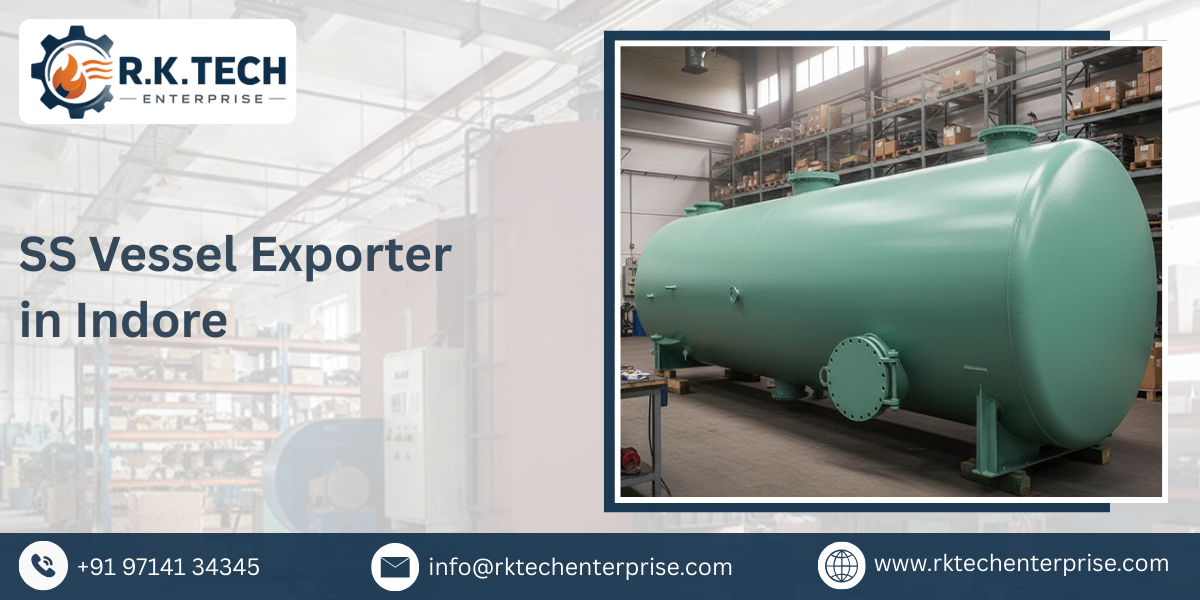
SS Vessel Exporter in Indore
R.K.Tech Enterprise
R.K.Tech Enterprise is a professionally managed engineering company specializing in the design, fabrication, and supply of high-quality stainless steel process equipment. With a focus on reliable construction, application-specific engineering, and consistent manufacturing practices, the company serves industries requiring durable and hygienic vessel solutions. As an experienced SS Vessel Exporter in Indore, we provide stainless steel vessels designed for different processing, storage, mixing, heating, and industrial requirements.
Our range includes SS Vessel, Stainless Steel Vessels, storage vessels, processing vessels, mixing vessels, and customized industrial vessels. Every vessel can be manufactured according to application requirements, material specifications, capacity, operating conditions, and installation needs. Customers looking for an SS Vessel in Indore can discuss their technical requirements with our team and receive suitable equipment solutions.
SS Vessel Exporter in Indore for Industrial Requirements
A stainless steel vessel is an engineered container used for storing, processing, mixing, heating, cooling, or handling liquids, semi-solids, powders, and other industrial materials. R.K.Tech Enterprise manufactures vessels with attention to material selection, fabrication accuracy, welding quality, surface finish, and dimensional consistency.
As a dedicated Stainless Steel Vessels Exporter in Indore, we understand that different industries require different vessel configurations. Food processing may require hygienic surfaces and easy cleaning, while chemical industries may require corrosion-resistant materials and specialized construction. Pharmaceutical applications may require smooth internal finishes and controlled fabrication standards.
The selection of an SS Vessel Price in Indore depends on several factors, including vessel capacity, stainless steel grade, thickness, configuration, accessories, surface finish, fabrication complexity, and customization requirements. Customers should therefore compare specifications rather than price alone when selecting industrial vessels.
Manufacturing Capability
R.K.Tech Enterprise follows an application-oriented manufacturing approach to produce stainless steel vessels for industrial use. The fabrication process can include material cutting, forming, rolling, welding, nozzle fabrication, surface finishing, inspection, and final assembly.
Key manufacturing capabilities include:
- Fabrication of stainless steel vessels in different capacities.
- Customized vessel dimensions based on plant requirements.
- TIG and suitable welding processes for reliable joints.
- Fabrication of cylindrical, vertical, horizontal, and customized configurations.
- Provision for nozzles, manholes, outlets, inlets, vents, and drain connections.
- Surface finishing according to process and hygiene requirements.
- Inspection of dimensions, welds, fittings, and overall fabrication quality.
The manufacturing process begins with understanding the customer's application and technical specifications. Material grade, vessel capacity, operating temperature, pressure conditions, and mounting arrangement are considered before production.
Types of Stainless Steel Vessels
Depending on the application, different types of vessels can be manufactured.
- Storage Vessels: Used for storing water, chemicals, oils, ingredients, and industrial liquids.
- Process Vessels: Designed for industrial processing operations where controlled handling of materials is required.
- Mixing Vessels: Equipped with suitable agitator arrangements for blending or mixing materials.
- Jacketed Vessels: Designed with jacket arrangements for heating or cooling applications.
- Pressure Vessels: Manufactured according to specified design and operating requirements where pressure service is involved.
- Customized Vessels: Developed according to customer-specific dimensions, connections, capacity, and process requirements.
An SS Vessel Exporter Near me search may provide many suppliers, but customers should evaluate manufacturing capability, material quality, fabrication expertise, customization support, and after-sales assistance before finalizing a supplier.
Working Principle of an SS Vessel
The working principle of an SS Vessel depends on its intended application. In a storage application, the vessel safely contains the required material while providing suitable inlet, outlet, vent, and drain connections. In a processing vessel, materials are introduced through an inlet and may undergo mixing, heating, cooling, reaction, or holding before being discharged.
For a mixing vessel, an agitator rotates inside the vessel and creates controlled movement of the material. Jacketed vessels transfer heat through the jacket surrounding the vessel wall. This allows the process temperature to be increased or reduced according to operational requirements.
Proper vessel design helps maintain process consistency, minimize contamination risks, and improve operational efficiency.
Customization Options
R.K.Tech Enterprise provides customization options because industrial processes rarely have identical equipment requirements. A vessel can be configured according to plant layout, process conditions, available space, and material-handling requirements.
Customization may include:
- Vessel capacity and overall dimensions.
- Vertical or horizontal construction.
- Stainless steel grade selection.
- Wall thickness according to design requirements.
- Nozzle size and orientation.
- Manhole and inspection opening configuration.
- Agitator and mixing arrangements.
- Heating or cooling jacket provisions.
- Support legs, saddles, brackets, and mounting structures.
- Surface finishing and polishing requirements.
Customers seeking the Best SS Vessel Exporter in Indore should provide complete technical specifications so that the vessel can be designed appropriately for the intended service.
Technical Information – Important Selection Points
Before purchasing stainless steel vessels, consider the following technical parameters:
- Material Grade: Select the stainless steel grade according to corrosion resistance, process compatibility, and operating conditions.
- Capacity: Determine working volume and total vessel volume based on the process requirement.
- Operating Temperature: Specify minimum and maximum process temperatures.
- Pressure: For pressure applications, define operating and design pressure clearly.
- Wall Thickness: Thickness should be selected according to design conditions and structural requirements.
- Surface Finish: Smooth internal surfaces may be required for hygienic or easy-cleaning applications.
- Nozzle Arrangement: Inlet, outlet, vent, drain, and instrument connections should match the process layout.
- Support Structure: Legs, saddles, brackets, or other supports should suit installation conditions.
- Agitation: Mixing requirements determine the suitable agitator arrangement and drive configuration.
- Inspection: Dimensional, visual, welding, and other applicable inspections should be considered according to the application.
Applications of Stainless Steel Vessels
Stainless steel vessels are widely used because stainless steel offers useful properties such as corrosion resistance, durability, cleanability, and strength. Typical applications include:
- Food and beverage processing.
- Pharmaceutical and healthcare manufacturing.
- Chemical and specialty chemical industries.
- Dairy and edible oil processing.
- Cosmetics and personal care manufacturing.
- Water and wastewater treatment.
- Industrial chemical storage.
- Engineering and manufacturing plants.
- Paint, resin, and adhesive processing.
- Research and process development facilities.
As an Industrial SS Vessel Exporter in Indore, R.K.Tech Enterprise focuses on supplying equipment suitable for varied industrial environments while considering the specific requirements of each application.
Maintenance of SS Vessels
Proper maintenance helps increase equipment service life and supports reliable plant operation. Recommended maintenance practices include:
- Inspect vessel surfaces periodically for corrosion, dents, cracks, or unusual marks.
- Check weld areas and connections during scheduled inspections.
- Clean internal surfaces according to the processed material.
- Inspect valves, nozzles, gaskets, agitators, and fittings for wear.
- Check suppor